Doepfer A-149-3
- Betala säkert med kort
- Maila oss, vi svarar snabbt!
\* Redigera dessa rader under Innehåll > Produktsida
Beskrivning
Art.nr: DoepferA1493
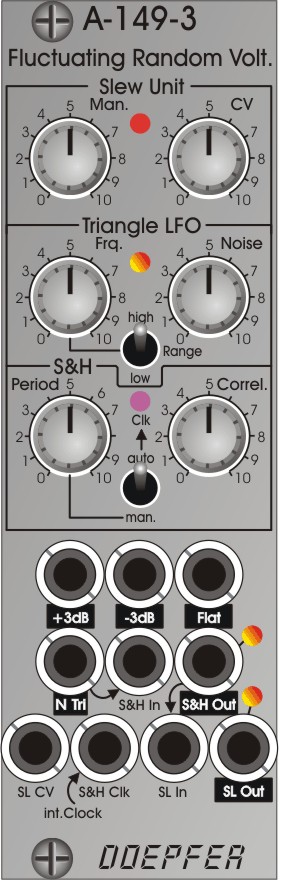
Module A-149-3 is based on the homonymous "Fluctuating Random Voltages" by Buchla. Compared to the historic original a lot of functions have been added. For example the user has access to virtually all internal signals (e.g. Noisy Triangle or S&H) and there are a lot of adjustable parameters which were fixed in the original. For example the frequency and noisiness of the internal triangle oscillator, the correlation of the S&H and manual or automatic frequency control of the S&H clock oscillator. The fixed internal connections of the original are wired to sockets in the A-149-3 and can be used also individually as the connections of the original are realized as normalled sockets. That way e.g. the S&H or slew unit can be used independent from the other units.
The functions in detail:
As in the original a digital noise signal is filtered in three different ways. The three "noise flavours" are available at three sockets and can be used for all kind of noise applications
The "N Tri" signal is normalled to the signal input of the subsequent Sample&Hold unit (S&H). The clock signal for the S&H is generated by an internal rectangle oscillator. This signal is normalled to the S&H clock socket and is displayed by an LED. One can select between manual and automatic control of the clock period by means of a toggle switch. In position "man." the period is controlled manually by the "Period" control. With control "Period" fully CCW one obtains the shortest period or highest frequency. Turning the control up increases the period or lowers the frequency. In position "auto" of the switch the period is controlled by the slew unit. In this position a vactrol is used to define the frequency of the S&H clock. This vactrol is controlled in the same way as the vactrols of the slew unit, i.e. the period of the S&H clock changes simultaneously with the slew time. In the historic original only the auto mode was available. There was no manual control available.
The S&H has another special feature: the Correllation control. It's a feedback function where shares of the S&H output are fed back to the S&H signal input and mixed with the actual S&H input signal. The result is slurring the signal like a sub-audio lowpass filter, kind of a "digital slew function" because the gradation of the signal persists.
The S&H output is availabe at the corresponding socket and is displayed with a dual color LED.
The S&H output is normalled to the signal input of the subsequent Slew Limiter unit (SL). The core of the slew limiter are two vactrols (vactrol = combination of a light emitting diode/LED and a light dependent resistor/LDR built into lightproof case). The brightness of the vactrol LEDs can be controlled manually (control "Man." of the slew unit) and by an external control voltage (socket "SL CV" with associated attenuator "CV" of the slew unit). The brightness of the vactrol LEDs is displayed at the top of the front planel. As already mentioned a third vactrol can be used to control the frequency of the S&H clock oscillator simultaneously to the slew limiter. The SL output is availabe at the corresponding socket and is displayed with a dual color LED.
Due to the access facilities to many of the internal signals and connections it's possible to use the sub-units also for other applications. E.g. the noisy triangle signal, the S&H unit (incl. correlation) or the SL unit can be used for other signals. The S&H clock can be applied also from outside to synchronize the S&H to other signals. If required the internal clock signal is available at a pin header of the pc board.
• 8 HP
- ButiksadressRoslagsgatan 19, 11355 Stockholm
- SkickNy
- TillverkareDoepfer