AJH Synth Ring SM Dark Edition
4 100 SEK
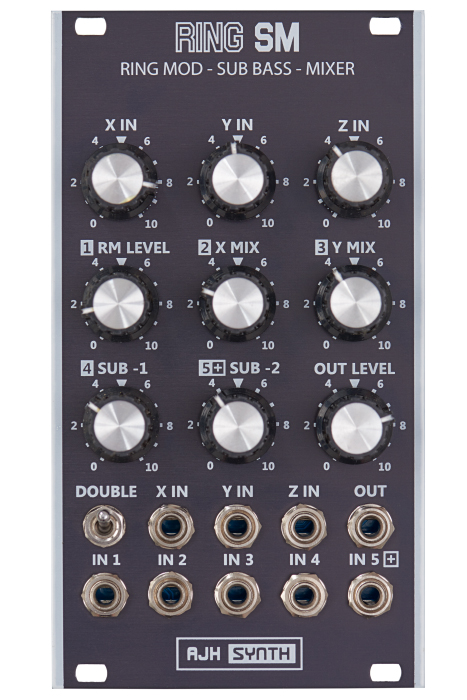
The AJH Synth Ring SM is a unique Eurorack module that features a three input discrete transistor Ring Modulator core, two shaped sine Sub Bass generators and a five channel discrete transistor mixer with extra distortion capability; all within 14HP of Eurorack Modular panel space.
- Betala säkert med kort
- Maila oss, vi svarar snabbt!
\* Redigera dessa rader under Innehåll > Produktsida
Beskrivning
Art.nr: AJHRingSM
The RING SM module is quite unique because its ring modulator circuit is based on a discrete transistor AC coupled Gilbert Cell design dating back to the early 1960's. The overload and distortion characteristics are rather different and more musically useful. There´s a third Z input in addition to the usual Carrier (X) and Modulator (Y) inputs seen on other ring modulator designs. The Z Input is actually a second modulator input that has a different phase relationship with the ring modulator core and it can produce a more resonant sound when it is used. All three inputs (X, Y, and Z) can be used simultaneously.
The “Double” switch connects the X (carrier) input to the Y (modulator) input, so that if a Sine wave or Triangle wave is applied to the X Input then this will be doubled and the RM output will be one octave higher than the X input - no Y input is necessary for this to be generated.
There are two independant Sub Bass Generators:
Sub Bass -1 produces a shaped sinewave output one octave below the waveform applied to the X IN Input. Sub Bass -2 produces a shaped sinewave output two octaves below the waveform applied to the X IN Input.
The Sub Bass waveforms are not square waves but vary from a trapezoid wave with rounded edges at lower frequencies to sine like waveforms at higher frequencies and are useful up to 1kHz. They have a much lower harmonic content than regular square wave subs, they have been specifically designed sit much better in a mix and appear to have more drive and punch.
The “Double” switch connects the X (carrier) input to the Y (modulator) input, so that if a Sine wave or Triangle wave is applied to the X Input then this will be doubled and the RM output will be one octave higher than the X input - no Y input is necessary for this to be generated.
There are two independant Sub Bass Generators:
Sub Bass -1 produces a shaped sinewave output one octave below the waveform applied to the X IN Input. Sub Bass -2 produces a shaped sinewave output two octaves below the waveform applied to the X IN Input.
The Sub Bass waveforms are not square waves but vary from a trapezoid wave with rounded edges at lower frequencies to sine like waveforms at higher frequencies and are useful up to 1kHz. They have a much lower harmonic content than regular square wave subs, they have been specifically designed sit much better in a mix and appear to have more drive and punch.
- ButiksadressRoslagsgatan 19, 11355 Stockholm
- SkickNy
- TillverkareAJH Synth